Topics

Showing posts with label Essential Biotech Beans. Show all posts

Making Chickens Lay Falcon Eggs: The Science of De-Extinction

Have you ever dreamed of snapping pictures of a live wooly mammoth at the zoo? Perhaps you could buy a mammoth wool beanie in the gift shop afterwards, or pay a little extra for a ride on the mammoth's back.
And maybe you've thought, "Science has come so far now ... why not try cloning a mammoth? We have the technology, let's do this thing!" You're not alone in those thoughts. In fact, there's a dedicated group of scientists working on this technology of "de-extinction". And they've made some astounding progress ...


Synthetic Life - Cookin' Up a Cell from Scratch

Science fiction authors have long predicted the day when rogue researchers would create synthetic life. From ancient Greek mythology's Prometheus who created men from clay, to Mary Shelley's Dr. Frankenstein who brought dead flesh back to life in 1818, to modern stories such as Flubber. Humanity has always been in awe of the intricacy of living things, and desired the power to bestow life.

Well, we've arrived. Mostly. In May, 2010, the J. Craig Venter Institute (JCVI) announced that they had successfully assembled the first synthetic life form. What exactly did they mean by that?

Bioinformatics: Genome Assembly

Assembly-Solving Really Big Puzzles

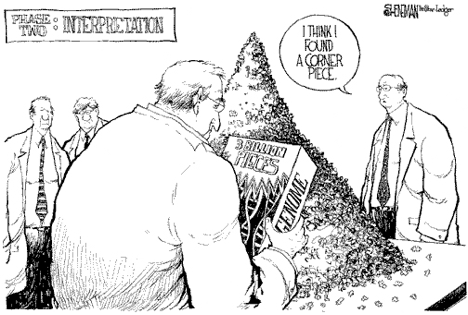
One of the primary duties of a Bioinformacian is to combine little pieces of DNA into bigger pieces. When scientists sequence the genome of a species, it doesn't spit out of a machine in one magical lump. Sequencing machines (that read DNA sequences) produce lots of little sequences of DNA (strings of A's, T's, G's, or C's) 50-700 base pairs (bps) long. They spit out millions of them. The challenge of bioinformatics is to assemble those millions of short reads into the full sequence of the genome. Imagine shredding a textbook and putting the pieces back together. This process is called (no surprise here) Assembly, since we're assembling pieces of DNA into a larger sequence. This process really made a splash in 2003 when the human genome was sequenced ...

Battling Malaria with ... Baker's Yeast?


According to the World Health Organization (WHO), malaria killed an estimated 655,000 people, mostly children, in 2010.  Artemisinin is an effective antimalarial  drug recommended by the WHO to be used in combination therapies. Artemisinin-based treatments could prove to be a silver bullet for the malaria scourge affecting developing areas of the world. There's just one catch: artemisinin is derived from Artemisia annua (Wormwood), an herb. Artemisia farming depends on the weather. Artemisinin may be only a small, small part of the overall plant mass, meaning that a great deal of resources (water, land, etc) are needed to produce small amounts of the desired drug. Thus, the current method of artemisinin production is unpredictable and inefficient. Queue, genetic engineering.