Genetically Modified (GM) Foods


Are Genetically Modified (GM) Foods Safe?
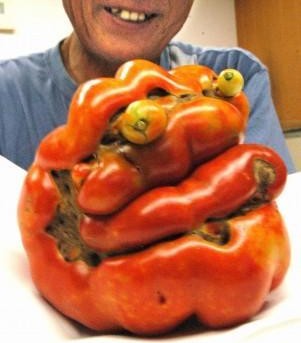

A recent post on Facebook again sparked my interest on this topic.  No, it had nothing to do with the beastly fruit above that I have named Tomonster.  The Facebook post described apples that have been genetically modified so that they do not brown after they are cut.  Are they safe?  Will they look like Tomonster?  Will eating a GM apple make you look like Tomonster?  What is GM food anyway?  
To answer these questions, let's start with the history of genetics, from breeding to genetic modification in a lab.

Breeding

Thousands of years before the discovery of DNA, people understood that reproduction in humans, animals, and plants generally produces similar offspring.  In horses, for example, breeders have used this knowledge to concentrate their favorite traits by choosing the fastest, strongest, or most beautiful parents to have offspring together.  A strong mother and a fast father could have a child that is both strong and fast.  By choosing which horses bred with each other, breeders crossed favorable traits and influenced the gene and trait pool of the next generation.  
Many critics of genetic modification will claim that we should not eat foods that are haphazardly thrown together by man.  They're not talking about the birthday cake I made for my wife last year, but her red velvet cake with cream cheese frosting was about as natural as the locally-sourced 'all-natural organic' strawberries and apples that you can pick up at the farmer's market on Saturday morning.  Breeding foods and domesticated animals has been going on for so long that none of us would even recognize the taste or appearance of a strawberry or apple from thousands of years ago.  My grandfather was born before the first Fuji apple was ever grown, so how 'natural' could it be?

Genetic Modification

If you've taken a biology or genetics class, you've undoubtedly heard of Gregor Mendel and his infamous pea plants.  Simply put, he discovered that traits are inherited in packets, which we now call genes.  A century after Mendel's work, the structure of DNA was discovered, sparking our understanding of the Central Dogma.  Now, we have entire single-celled organisms built from synthetic DNA. 

GM food is not nearly as complex as building a new apple from scratch.  For now, genetic modification is the ability to copy and paste the genes that nature has provided us, plus some minor modifications.  It is analogous to a mechanic putting Toyota parts into a Honda.  

In the case of the apples that sparked this blogpost, scientists have modified the apple DNA so that it cannot properly make a critical protein that causes browning in apples.  This simple change likely leads to an apple with identical chemistry to one without the change, other than the one missing protein.  It won't taste different, feel different, or test different in the lab.  It also will not turn brown.

There are many ways to modify an organisms DNA, but the simplest is to take existing DNA from one organism and put it into something else.  We are not yet at the stage where we create entire synthetic pathways (protein assembly lines) from scratch without any naturally existing blueprints.

Why All the Hype?

Why are so many people so adamantly against GM foods?  That's a great question.  I think the only answer comes from psychology, not biotechnology.  David Ropeik, a Harvard instructor, author, and risk consultant, explains the psychology very well in his article, "How We Perceive the Risks of GMOs."  In summary, most people who fear GM foods associate these foods with harmful chemicals or companies they dislike and may describe GM foods as 'unnatural' or GM food scientists as 'playing God.'  These people have a weak understanding of genetic modification, which harbors their perception of risk.  Ropeik believes that the greatest factor in people choosing to fear GM foods is what their friends do.  He warns that calling these people irrational, non-scientific, or just plain wrong will only cement their strong emotions as they respond defensively, reminding us that emotions are a critical and necessary part of being human.

Safety

Like people, food can only be judged by its quality, not by its heritage.  Whether the fruit came from a lab or a 2000-yr old plant, it could still be a poisonous berry or a delicious apple.  We can only know whether its safe by testing it.  In the case of the non-browning apples, three government organizations will regulate various aspects of production, which is more testing than has been done for any apple you've ever had before in your life.


Blinding the Blood Suckers

Imagine life from a mosquito's point of view. There are no dedicated mosquito grocery stores (the Red Cross hasn't even offered memberships like Costco). No, life isn't so cushy. Every blood meal comes with effort. 
Much like your family dog, the mosquito's sense of smell plays heavily into the search for food. Next time you see one of the little ladies on your arm sucking away your hard-earned blood, remember that they had to sniff you out before they could eat you. 
Well, like you, scientists don't much appreciate being eaten by mosquitoes either, and the current thinking is ... what if we could just remove their sense of smell?


Making Chickens Lay Falcon Eggs: The Science of De-Extinction

Have you ever dreamed of snapping pictures of a live wooly mammoth at the zoo? Perhaps you could buy a mammoth wool beanie in the gift shop afterwards, or pay a little extra for a ride on the mammoth's back.
And maybe you've thought, "Science has come so far now ... why not try cloning a mammoth? We have the technology, let's do this thing!" You're not alone in those thoughts. In fact, there's a dedicated group of scientists working on this technology of "de-extinction". And they've made some astounding progress ...


Metabolism and Molecular Vacation Planning

Human Reconstruction 2. What images does that title conjure up in your mind? Frankenstein is one possibility (he was sewn together or 'reconstructed' from dead body parts). But no, guess again. Surgery? Wax museums? Dolly Parton and Michael Jackson?

While the title may paint a mental picture of scalpels and sutures, the project itself is somewhat more tame (while just as ambitious as building a monster out of corpses).

Mapping human metabolism has the potential to revolutionize medicine the way Google Maps revolutionized vacation planning. But, back up a sec... what is metabolism?

3D Printing and Your Liver

Take a moment and imagine this scenario: a terrible accident happens to your close friend and his liver is severely damaged. He'll need a new one but the waiting list for a liver donation is so long that it's unlikely he'll get one in time.

What to do?

Tissue engineering to the rescue. Recent research has blended synthetic biology, 3D printing, and a spoonful of sugar to build you a new liver from scratch.


Mutants Among Us! Can Humans Evolve?


In the TV show Heroes, hundreds of people discover that they have superhuman powers.  My favorite power from the show is Hiro's ability to master time and space.  This is the only power in all of science fiction that I would prefer to Nightcrawler's poof (from X-men).  Just like X-Men, Heroes explains that these special individuals are a more evolved form of human.  Is this how evolution happens?  Is it possible to wake up with a genetic mutation that gives you added powers?  Do mutants usually wear black?


Tyler DeWitt, Bill Nye, and BioBeans


Have you ever wondered why anyone goes into science? Does it seem boring, dry, uninteresting, uncool, unlikeable and not-your-style? Or maybe, you sometimes secretly wish that you were "smart enough" to be a science geek but you just don't get it? 

If so, we're here to tell you that science isn't the problem. Science is anything but boring, uninteresting and uncool. You're not the problem either. You are definitely smart enough. What needs fixing is the middle man. The teachers. So what can you do to be a better science learner or teacher? Read on ...


Knome and Personalized Medicine

On February 2nd, the New York Times ran an article featuring an up-and-coming company, Knome. Knome provides a combined hardware-software platform for interpreting human genetic information. Soooooo... what do they provide? What does this mean for personalized medicine in the 21st century?


Fecal Matter Transplants to Stool Bank Donations

Meet Clostridium difficile; a common bacteria found in the gut of many perfectly healthy people. It is generally only one of hundreds of bacterial species happily tucked away in the warm confines of your and my tummies. However, C. diff, as it is affectionately known, is a lot like ivy growing in the garden. If someone regularly prunes it, if other plants crowd it a bit, it can be a beautiful member of the garden community. But, if something happens so that the gardener and the other plants don't keep it in check, the ivy will overgrow the house and tear up the walls.

What is *cough* the Flu Shot Anyway?


Last week my wife and I both got sick.  We both passed the opportunity to get flu shots.  Would it help?  What magic elixir can keep someone from being sick?  How does it all work?

The flu, or influenza, is a virus, which Matt described very well in his post Viruses - A Vector to Remember. This particular virus is one bad hombre.  What makes this virus so bad is that the DNA that it carries makes people sick, sometimes very sick.  In fact, during World War I a flu epidemic known as the Spanish Flu infected half a billion people and may have killed as much as 3% of the world's population.

The Spanish Flu was not the first virus to leave a big wake of destruction.  Toward the end of the 1700s, smallpox killed nearly half a billion people in Europe alone.  While you are likely to catch the flu in your life, you will not get smallpox, thanks to the smallpox vaccine.

PCR for the Masses

Admittedly, molecular biology and synthetic biology have historically been hobbies for the well-off and well-to-do. At least, that is, if a researcher wanted quality equipment. A recent Do It Yourself (DIY) revolution (a.k.a. the Maker revolution, which is closely allied with the Open Source revolution) is attempting to change all that. Here we present to you one example of how clever people are working to bring the tools of biotechnology to your garage or bedroom laboratory. Meet OpenPCR.


iGEM - SynBio for Self Starters

If you find yourself wanting to learn more, and do more with synthetic biology and bioengineering, there is no need to wait until you have a Ph.D. You can start engineering cells immediately through a competition called iGEM.

The International Genetically Engineered Machine competition is the world's premier synthetic biology competition, initially for university students, but now available for high school students as well. Student-led teams design their own projects, work over the course of a summer to build their bug, then they head off to regional, and then the world, competition to see how they measure up.

Synthetic Life - Cookin' Up a Cell from Scratch

Science fiction authors have long predicted the day when rogue researchers would create synthetic life. From ancient Greek mythology's Prometheus who created men from clay, to Mary Shelley's Dr. Frankenstein who brought dead flesh back to life in 1818, to modern stories such as Flubber. Humanity has always been in awe of the intricacy of living things, and desired the power to bestow life.

Well, we've arrived. Mostly. In May, 2010, the J. Craig Venter Institute (JCVI) announced that they had successfully assembled the first synthetic life form. What exactly did they mean by that?

Zombie Enzymes

Biomimetics is a field of engineering that seeks to learn new engineering design principles and technologies from nature. As an engineer or scientist, suppose you wanted to move on in your career, become a MAD scientist (generally self-employed, better pay, more time at home ...), and take over the world with a zombie army?

The technology isn't in use yet (by humans), but never fear. Nature is here. Biomimetics can serve you, be you mad scientist, disgruntled university student, or Halloween prankster. It's all in the enzymes.

A recent article in the New York Times Science section reviewed the current issue of the Journal of Experimental Biology. The whole issue is dedicated to parasites in nature that turn their hosts into zombies and force them into subservience.

Viruses - A Vector to Remember

Invisible killers. An unsanitary butcher in Indonesia shakes hands with a tourist who sneezes in the airport and contaminates a traveler to New York who exposes a taxi driver who dooms the city to mortality en masse. Is this your view of viruses? It certainly is the view of the average person on the street (who won't want to shake your hand after you broach the topic of viruses). Perhaps your first thought was of a computer virus and a blue screen error. Viruses are bad, right?

WRONG! Viruses can be extremely bio-awesome, if you give them a chance. They are a hot tool in biotech, and one that is under-appreciated.


Bioinformatics: Genome Assembly

Assembly-Solving Really Big Puzzles

One of the primary duties of a Bioinformacian is to combine little pieces of DNA into bigger pieces. When scientists sequence the genome of a species, it doesn't spit out of a machine in one magical lump. Sequencing machines (that read DNA sequences) produce lots of little sequences of DNA (strings of A's, T's, G's, or C's) 50-700 base pairs (bps) long. They spit out millions of them. The challenge of bioinformatics is to assemble those millions of short reads into the full sequence of the genome. Imagine shredding a textbook and putting the pieces back together. This process is called (no surprise here) Assembly, since we're assembling pieces of DNA into a larger sequence. This process really made a splash in 2003 when the human genome was sequenced ...

Bioinformatics: DNA = Bioinformation

CLC Bio


Rocket Science is for Kids (No offense to all the rocket scientists out there)
As we've discussed, informatics by itself is only about as cool sounding as cutting grass. But we're not talking about just any old informatics. We're talking about bio-informatics. In this case, the coolness factor increases by the number of bases stored in GenBank. You'll find out how many that is in a minute. For now, just know that bioinformatics is really cool and really, really important for modern biotechnology. So important in fact, that without it, biotech wouldn't exist. My job is to convince you that such is the case. We'll start by talking about DNA sequence. We'll talk about where it comes from and what it's used for. 

Battling Malaria with ... Baker's Yeast?


According to the World Health Organization (WHO), malaria killed an estimated 655,000 people, mostly children, in 2010.  Artemisinin is an effective antimalarial  drug recommended by the WHO to be used in combination therapies. Artemisinin-based treatments could prove to be a silver bullet for the malaria scourge affecting developing areas of the world. There's just one catch: artemisinin is derived from Artemisia annua (Wormwood), an herb. Artemisia farming depends on the weather. Artemisinin may be only a small, small part of the overall plant mass, meaning that a great deal of resources (water, land, etc) are needed to produce small amounts of the desired drug. Thus, the current method of artemisinin production is unpredictable and inefficient. Queue, genetic engineering.

Molecular Biology - The Portal to Biotechnology


Suppose a researcher wants a cell to produce a particular protein—say, Green Fluorescent Protein (GFP). Now that we understand the central dogma, the researcher's path is pretty straight forward. First, the researcher would need a copy of the gene, usually from an existing source, like jellyfish DNA. There are many ways to insert the gene into a cell, and more ways are being explored. Let's say for now that the researcher puts the GFP gene on a plasmid (a circular piece of DNA that is self-replicating in a cell). To cut-and-paste a piece of DNA, scientists use restriction enzymes, which are like molecular scissors. They recognize specific sequences of the DNA alphabet and sever double stranded DNA in predictable ways. DNA ligase is like the glue, that bonds strands back together. 

Setting up Shop: RNA to Proteins


Ribonucleic acid (RNA to its friends, including us) is a sibling to DNA. You may have noticed from the name that RNA is really just DNA without the "deoxy". Much of what has been said about DNA applies to RNA as well. RNA contains genetic instructions, is made up of an alphabet, can base pair with DNA or other RNA strands. However, there are some crucial differences. The alphabet is different—instead of T, RNA uses a U (for Uracil). While DNA is usually found as a double-stranded molecule, RNA is almost always single stranded.  You can think of RNA as a working copy of the DNA, a copy that is intended to be recycled after use. RNA is disposable, because it's main purpose is to serve as a template for protein machinery and protein machinery is a huge part of biotechnology.